I am writing this on April 19th with my leg stretched out in front of me, locked inside a brace that feels like it weighs ten pounds. It presses against the back of my knee like a quiet, constant argument. The foam edges dig in just enough to remind me they're there. The room is still. Outside the world is moving at its usual impossible speed and I am here, grounded in the most literal sense, watching it from a distance that has started to feel less like limitation and more like clarity.
Last May I tore through my ankle badly enough that the healing itself became a kind of education. And now here I am again, leg extended, brace on, relearning for the second time in less than a year what the body already knew and the mind had to catch up to.
What I didn't expect was what the stillness would show me. Forced rest has a way of revealing what constant movement was covering up. You stop running and the thing you were running past is suddenly right in front of you.
I've been building at the intersection of music, culture, and systems for a while now, trying to understand not just how things are made — but who actually gets to keep them.
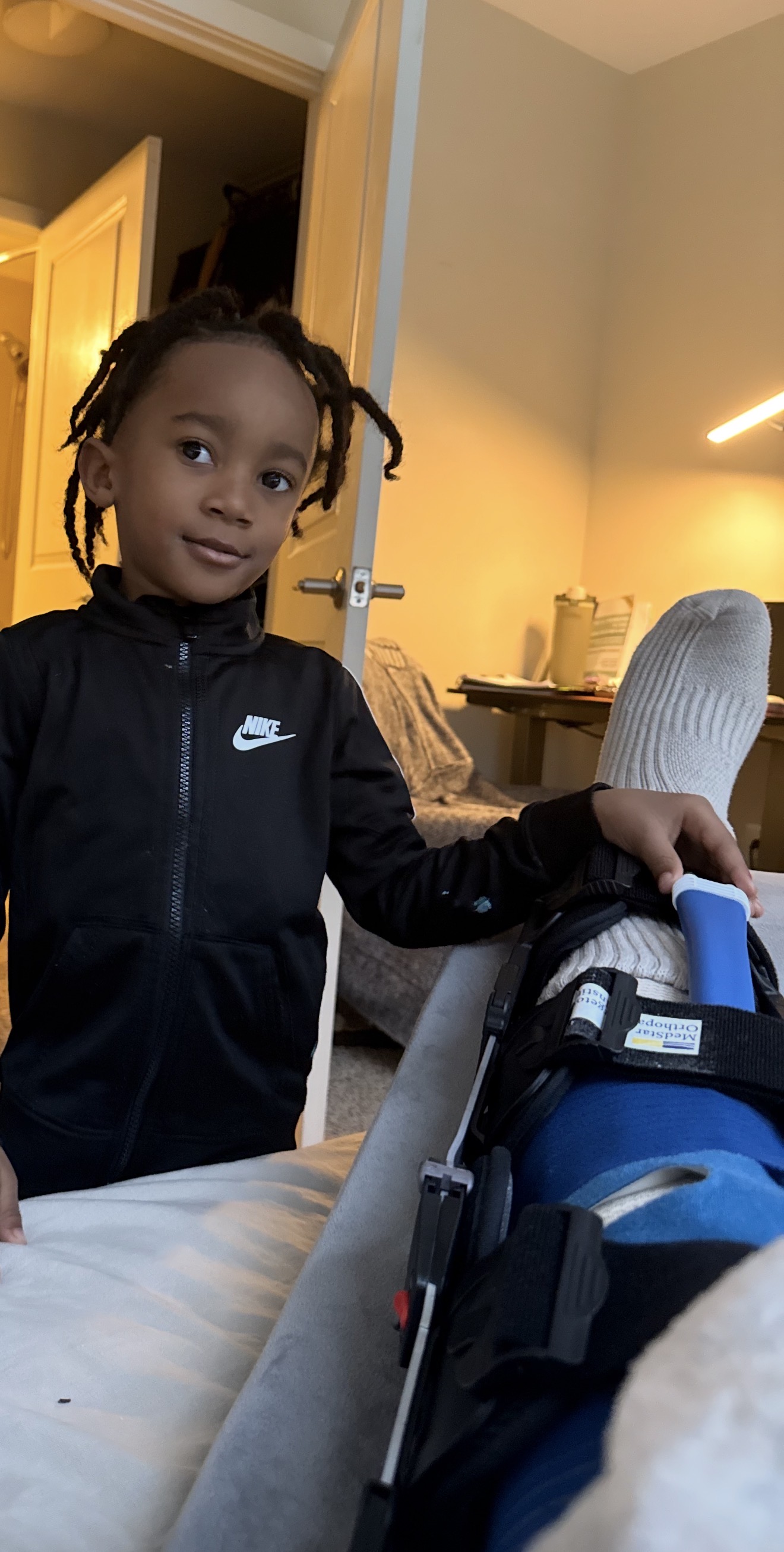
I have a son. I watch him every day create something from nothing — paper, tape, whatever he can reach, building worlds with his hands before the world has had a chance to tell him what's possible. I know what's coming. I know because it came for me too. The slow pressure to shrink. To be practical. To stop building and start fitting. It didn't work on me. I'm still here. Still building. And everything I'm doing now is partly for him, so that when the world comes with its limitations, there's already a structure in place that shows him another way.
The illusion has always been that we don't have a choice. That the arrangement is just the way things are. That the gift is enough and the ground beneath it is someone else's concern. I've been sitting still long enough now to see that clearly. And once you see it you can't accept it the same way anymore.
"This is one of those things."
There is a particular kind of loss that doesn't announce itself. It arrives disguised as progress. As streams, as placements, as visibility inside systems that were never really built for you. You pour something real into the world and watch it move through channels you don't control, toward audiences you can't reach again, generating value that settles everywhere except where it started.
"The work survives. The power doesn't transfer."
That's the arrangement.
Most people accept it so early they forget there was ever another option. Some people accept it so completely they spend their whole lives mistaking exposure for equity, mistaking the stage for ownership of the stage.
We've seen this pattern play out across generations. Artists who defined entire sounds, entire eras, entire ways of feeling alive, still on the road decades later. Not because the work didn't matter. Because the system underneath it was never theirs. The music traveled everywhere. The ownership didn't follow.
And the most chilling version of that story isn't obscurity. It's Prince, one of the most commercially successful artists in the history of recorded music, writing the word "slave" on his face in protest. Not as metaphor. As a precise description of what it felt like to create endlessly for a system that owned the creations. He eventually won his masters back. Most people never get that fight, let alone win it. Most people don't even know they were supposed to have it.
"That's not an accident. That's the design."
The design is this: make the gift feel like enough. Celebrate the talent loudly enough that the question of ownership never quite surfaces. Let the artist feel seen, feel heard, feel legendary, while the actual equity moves somewhere quieter. The illusion of arrival. The appearance of success while the infrastructure, the masters, the publishing rights, the platform, the memory of the work itself, belongs to someone else entirely. And the cruelest part is that the illusion is maintained not through force but through culture. Through the idea that asking for more than recognition is somehow ungrateful. That the gift should be its own reward. That people like us don't own things. We make them.
Think about what happened to MySpace. To Vine. Think about every platform that rose, captured something true and alive about how people express themselves, then folded or pivoted or got acquired. And what was left for the people who built the culture that made those platforms worth anything in the first place? The music. The videos. The phrases and the dances and the ways of seeing that spread because they were real, because they came from somewhere specific, from a particular people with a particular way of moving through the world. Gone. Or worse, absorbed. Turned into data, into case studies, into revenue for people who were never in the room when any of it was made. The creators started over. The platforms got acquired. The arrangement continued.
Consider "you the birthday." A phrase that didn't start on TikTok. Nothing that real ever does. It probably started the way most things that matter start: during a pre-game, three friends at a kitchen counter, a half-empty bottle of regrets in the midst. No script or plan to go viral. Before it spread everywhere, there was "chicken alfredo music" — the sound people use to describe Hunxho and other artists who make music that carries a certain type of vibe. "You the birthday" didn't arrive from nowhere. It came out of that same world. Same culture, same frequency, just a different expression of it. And before chicken alfredo music there was "basic." Same idea, different generation. The language evolved but the way we've always moved stayed the same. That's how our language works. It doesn't start over. It carries forward. They come from a language that is truly ours.
You the one. You is tea. You the birthday. Not a compliment. Elevation. It turns a person into an event, into the reason the room exists at all, into the thing everyone came to see without knowing they were coming to see it. We literally are the room. We bring the seasoning, the music, the language, the warmth and the love.
And we keep getting it all extracted or taken from us.
TikTok didn't create that. It found it, the way it always finds things, amplified it, abstracted it just enough to travel, and spread it across millions of screens to people who had never been in that kitchen, never been part of that conversation. And then the media covered it and called it a TikTok phrase. Labeled it. Packaged it. Added a citation that pointed nowhere near the source. Sent it back to us with someone else's name on the box. That's not a small thing. That is the whole story told in miniature. That is the arrangement, running exactly as designed.
Then there's Walter. Mr. Tendernism. Unc. A man whose energy was so genuine, so rooted in love for his craft, that people drove from all over the country just to be near it. Keith Lee showed up and tried to hand him five thousand dollars. Got turned away without ever getting to speak to him. That alone told you everything.
The full story came out piece by piece. Walter had suggested the barbecue idea in the first place. He built it from the inside. And when it blew up, he still didn't own it. When the community found out, something moved. An attorney filed the trademark and gifted it back to him before anyone else could claim what was already his in spirit. A GoFundMe raised over fifty thousand dollars in days. Walter walked. Now he does pop ups, private events, and interviews — building something that's actually his.
We loved him because he reminded us of someone we knew. Our unc. Not the internet's version of that word, watered down and turned into a punchline, but the real one. The man in the family who knew everything, fixed everything, loved hard and asked for nothing back. Someone who gave everything to the thing and expected the thing itself to be enough. And it almost wasn't. Because it rarely is.
What Walter got was a victory, yes. But it was also a window into everything we've never had. How many people who were the birthday never got their moment. How many creators made the thing that made the platform and walked away with nothing but the memory of having made it. How many artists built genres, built movements, built entire vocabularies of feeling that the culture absorbed and monetized and celebrated while the infrastructure around it quietly transferred to other hands. And how much of that came not from malice alone but from a lie so old and so thoroughly repeated that it started to feel like nature. The lie that participation was the same as ownership. That being in the room meant you had a seat at the table. That the royalty statement told the whole story.
Baldwin wrote about the exhaustion of performing your humanity for people who have already decided what you are. There is a creative version of that exhaustion too. The one that comes from pouring your gift into systems designed to extract value while returning as little power as possible.
The music gets made. Then placed. Then streamed. Then licensed. And somewhere in all that movement the person who made it becomes the least powerful actor in their own story. The illusion holds because from the outside it looks like success. It looks like arrival. It looks like everything you worked for. Until the only thing left is the performance itself, the road, the stage, the act of creating without ever having owned what the creating produced.
I've loved making music my whole life. But the creative side has to meet infrastructure at some point, or the work gets lost. Not lost like forgotten. Lost like displaced. Existing somewhere it was never meant to live, serving a purpose it was never made for. I didn't fully understand that until I had no choice but to sit still long enough to see it clearly.
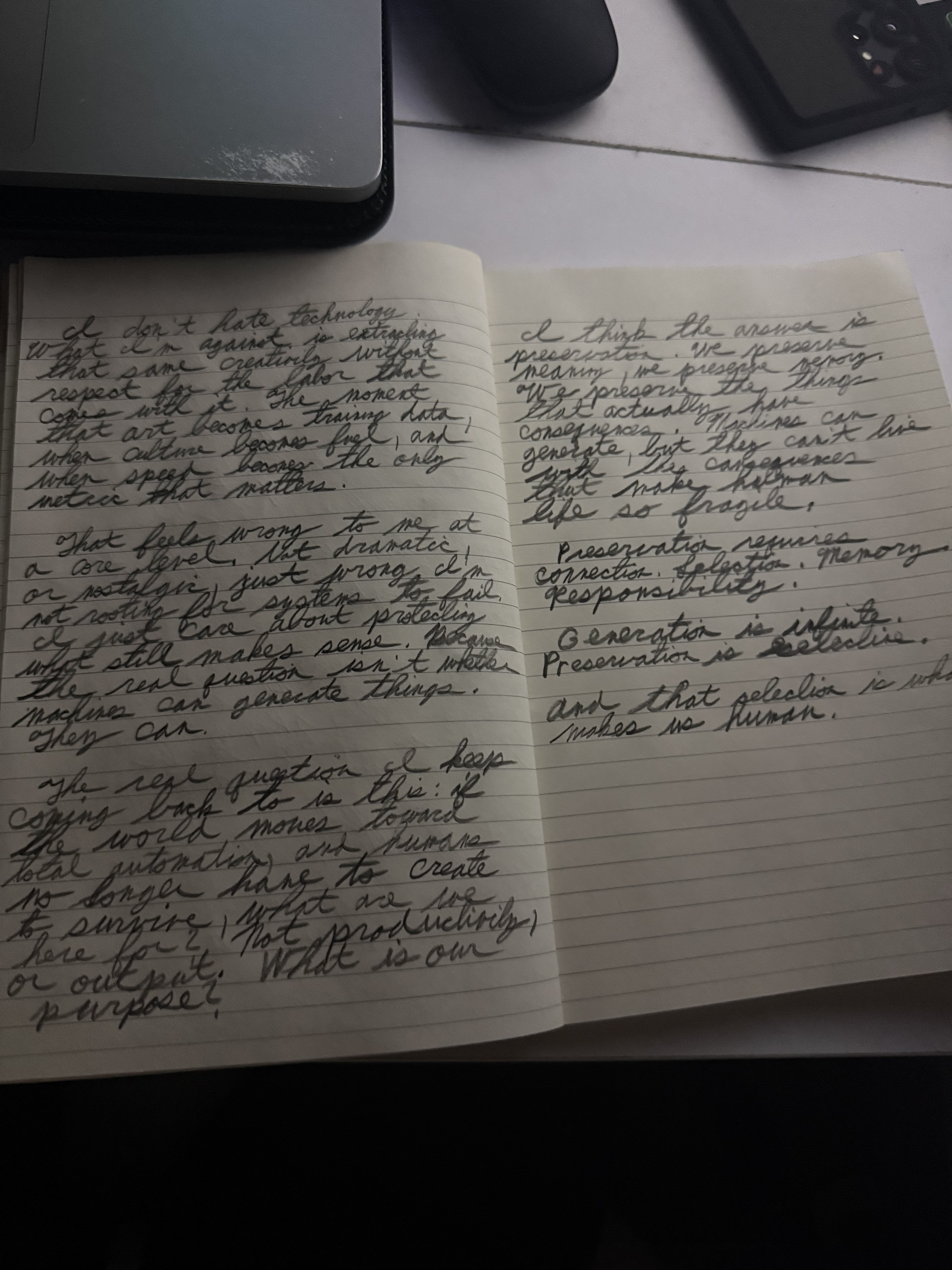
AI is infrastructure. For the first time, at a scale that doesn't require a corporation standing behind you.
Something shifted for me last year, mid-build. I sent a message with barely any context and what came back was exactly what I meant. My tone. My visual language. The particular way I move through an idea. Not because the tool was magic. Because I had been building with it long enough that the context had compounded. It had learned me the way a real collaborator learns you. Not from one conversation, but from the accumulation of all of them. It remembered me. And in that moment I understood something I hadn't had language for before. This is what institutions have always had. What labels had. What publishers had. What platforms still have. Systems that remember. Infrastructure that compounds. The ability to scale a vision without losing the original signal. Creators have always had the signal. We just rarely had the structure. And without the structure, the signal eventually passes through us into someone else's hands.
That's the illusion completing itself. The signal is celebrated. The structure is captured. And the source keeps moving, keeps creating, keeps pouring, not realizing that the pouring and the owning were never the same thing.
America is moving fast right now. Faster than most people have language for. The systems that were supposed to hold, economic, cultural, institutional, are shifting in ways that are hard to track and harder to trust. And what I keep returning to, the thing that feels true underneath all of it, is that the people who will be okay are the people who own something. Not just creatively. Structurally. Spaces, platforms, systems, memory. Something that cannot be absorbed when the ground shifts. Something that doesn't disappear when the platform pivots or the label restructures or the algorithm changes overnight.
I don't say that from a place of certainty. I say it from the same place you're probably reading it from. Trying to figure out what holds. Trying to build something real in the middle of a moment that keeps changing shape. Sitting with the weight of that, sometimes literally, leg out, brace pressing in, the room quiet, the world still moving, and choosing to build anyway. Not because I have it figured out. Because the alternative is accepting the arrangement. And I've seen where that ends.
Every decade a new platform rises. A new place to pour yourself into. And every decade the same question goes unanswered. What carries over? What do you actually keep? The followers don't transfer. The content gets archived or deleted. The culture you created becomes the case study for the next platform's pitch deck. And you start over. Again.
The arrangement updates its interface. The terms stay the same.
Unless you own something that doesn't depend on the platform to exist. That's what the records that last always understood, even when the people who made them didn't get to benefit from it. They were built to unfold. To mean something different depending on where you were in your life when you came back to them. They survived formats, survived platforms, survived entire industries restructuring around them, because the thing itself was so rooted it couldn't be extracted, only borrowed. The tragedy is that so many of the people who made those records never owned them. The music outlasted them. The structure never transferred.
That's the model we're breaking. Not faster. Not louder. Rooted. Owned. Built on ground that belongs to you. This is not a tool cycle. This is a fight for who gets to own the culture that comes out of this moment. Who holds the memory. Who controls the archive. Who builds the systems that decide what gets preserved and what disappears. The fight has always been there. What's different now is that the tools to win it are actually available. Not to corporations first. To anyone willing to learn them, sit with them, let them compound into something that remembers you.
I couldn't watch that from the sidelines. Not out of ambition. Out of awareness. Out of knowing exactly what it costs to make something true and watch it dissolve into someone else's system. Out of understanding, finally, that the illusion has always been the point. The illusion that we have to accept what's given. The illusion that we can't chart a new path. The illusion that the gift is enough and the ground beneath it is someone else's concern.
"The ground is the concern. The ground is everything."
I'm not building because it's the strategic move.
I'm building because I know what it looks like when the arrangement reaches its conclusion.
I'm building because somewhere between a torn ankle and a ten pound brace and a room that forced me to finally stop moving, I saw clearly what I'd been moving past.
I'm building because the alternative is writing "slave" on your face just to get back what was always yours.
And I think you might be here because some part of you already knows that too.