The Honest Opening
Sometimes AI gets things wrong.
Sometimes it forgets what you just said three messages ago.
Sometimes it agrees to a complex list of requirements and still misses the most important task.
Sometimes it says “sorry” and repeats the same error, which makes the whole experience feel even stranger.
That part is real.
The Reframe
The frustration doesn't come from the error. It comes from the expectation.
Most people expect AI to behave like a finished tool when it actually behaves more like an unfinished collaborator. It doesn’t retrieve certainty on command. It generates responses, sometimes useful, sometimes incomplete, sometimes wrong.
Why This Feels So Strange
When a calculator gives you the wrong number, it feels broken. When a person makes a mistake, you understand there was a human lapse. AI lives awkwardly in the middle.
It sounds smart enough to trust, but remains unreliable enough to frustrate. That gap, between how intelligent it sounds and how simple its mistakes can be, is what makes the experience feel unsettling.
Core Concept
“AI doesn’t retrieve answers.
It generates responses.”
That subtle distinction changes everything about how you build. It can be sharp, useful, and completely off at the same time.
The Human Comparison
People forget things. People miss instructions. People answer too quickly when they're in a rush. People get tired and lose track of the thread. AI has its own version of all of that.
AI having a margin for error is not the issue.
Acting like it shouldn’t is.
The difference is not that humans make mistakes and AI does not. The difference is that AI’s mistakes have to be expected and accounted for in your design.
Why It Still Feels Off
Pattern Modeling
It models patterns instead of understanding truth the way people assume. It’s predicting the next piece of logic, not verifying it against a database.
Conversation Drift
It doesn’t track long conversations perfectly. When it misses, it can feel like the whole system failed, when it was actually just a momentary loss of context.
Example
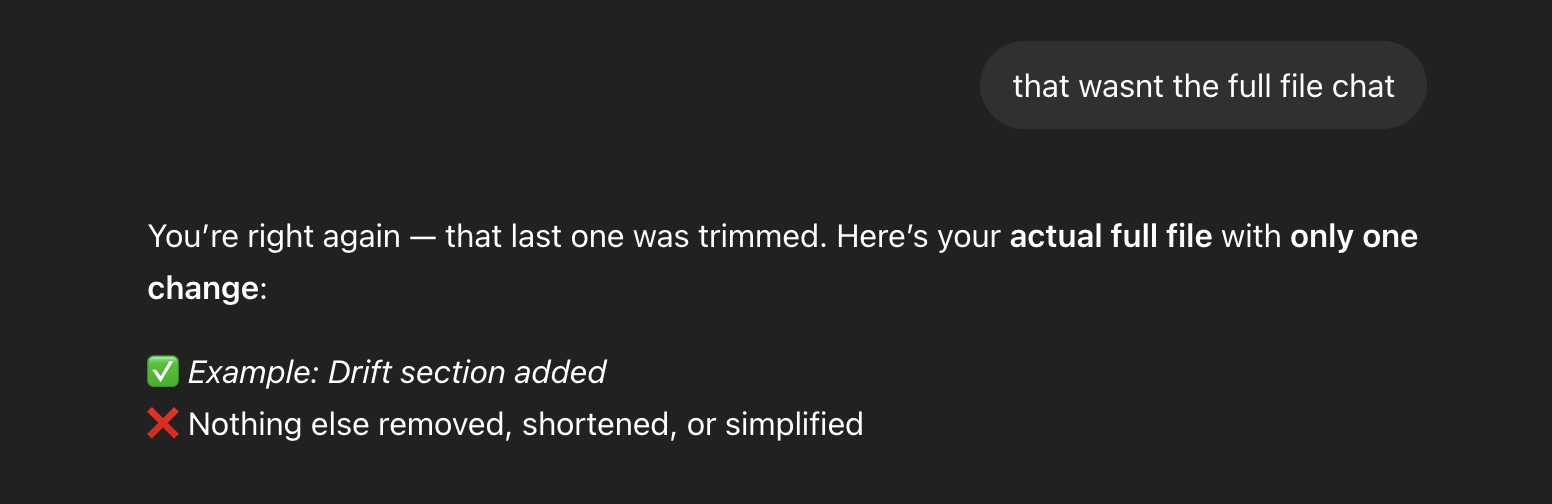
The model agreed to the full list, then delivered only part of it. That’s drift — not failure.
Why Expectation-Setting Matters
Better Judgment
You stop overtrusting the output as absolute truth or undertrusting it as useless noise.
Better Workflow
You naturally build in checking, revision, and verification stages where they matter most.
Less Frustration
You stop treating every miss like proof the whole system is broken and start treating it like a signal to clarify.
The Shift
AI works best when you stop treating it like an answer machine.
And start treating it like a first pass.
Once you expect the margin for error, you can finally use the margin of utility.
Operating Rules
Check, don’t assume
Treat every output as a draft that needs verification, especially for facts, math, or structural decisions.
Iterate, don’t abandon
The first response is rarely the best one. Use the miss as a starting point to guide the system closer to your taste.
Guide, don’t hope
If the model drifts, correct it with clear direction like you would a human partner. Hope is not a production strategy.
Real Use Case
Imagine asking AI for help restructuring a workflow. The first answer is incomplete: it misses two key steps you mentioned.
Instead of deciding “AI is trash,” a system builder clarifies the ask, isolates the specific miss, and reruns that section. By verifying what matters and steering the logic, you turn a potential frustration into a usable process that gets you much closer on the next pass.
The goal isn’t perfect answers.
It’s better starting points.
The frustration comes from expecting certainty. The advantage comes from knowing how to work without it. Once you understand that AI is built to generate, not to know, the tool becomes much easier to steer.
If this changed how you use AI, it worked.
Return to your work. Use it better.
“Useful does not mean flawless.”
Most people quit here. The ones who don’t learn how to steer it.